
Case Management
-
Description
Case Management is the primary component of real change in the lives our clients and is what differentiates us from organizations in a similar line of service. We want to support our clients with wraparound services, not just house them or feed them. It’s crucial that we hear their stories and journey with them to a better future.
Instead of asking those in need, “What did you do?” we ask, “What happened to you?” Our clients didn’t just make bad choices that got them into the situation they’re in today. More times than not, our clients didn’t know the right choice to make because no one showed them the way. They may not have been taught, but often grew up in traumatic households that never gave them a picture of a supportive family. That’s where case managers step in.
People in poverty have very little, if any support, especially if they’ve exhausted their resources—like friends and family. Case managers bridge the gap between what someone is trying to accomplish and offer the resources in order to actually move forward in life. They support clients so that they not only get them off the streets, but into a better life that keeps them off the streets.
It’s also the most critical component in our “Housing First” approach, which believes housing is a human right and that people need basic necessities like a place to live and food before they can focus on issues like substance use, finding a job, or budgeting.
Process
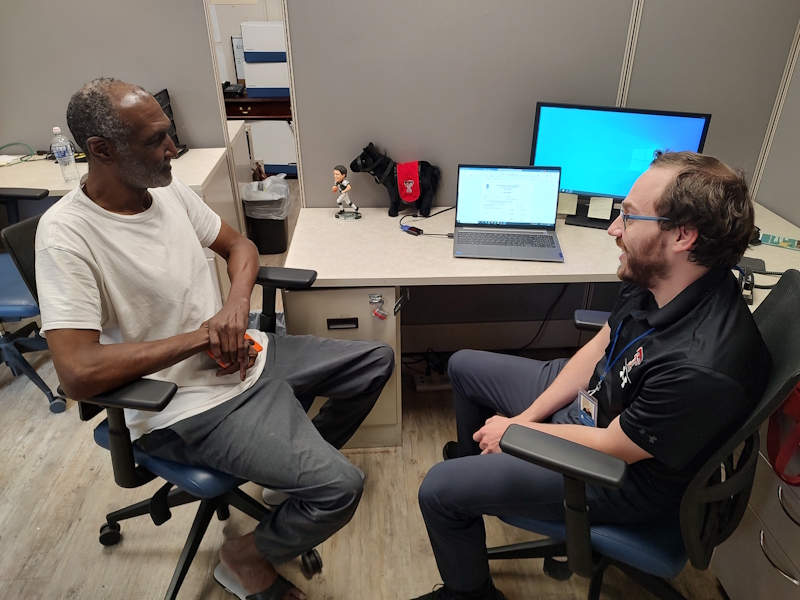
All clients have a case manager that they typically meet with on a biweekly or monthly basis. Each case manager has about a 25-person caseload. The case manager and client work together, complete a needs assessment, and develop an individualized service plan. Their main goal is to figure out what has prevented a client from securing housing and the steps they will need to take to obtain it within six months.
In order for this to happen, some clients submit applications to Louisville Metro Housing Authority and the Section 8 Housing Choice Voucher program to be placed on the waitlist, which the client must check periodically. Another option is to complete the Common Assessment, which is offered by Family Health Centers Phoenix. Then, depending on their score, clients can qualify for a housing voucher or be placed in permanent supportive housing based on a documented disability. A third option is for clients to work, save money, and rent an apartment.
Case managers help them in the following areas—housing, physical and mental health, drug and alcohol use, financial stability or debt reduction, legal issues, education, employment, parenting, daily life skills, and socialization or support networks. The case manager also makes referrals to basic non-therapeutic support services, such as providing resources to get food stamps, budgeting properly, and ensuring they have all of their personal IDs like a driver’s license or birth certificate.
The case manager can also refer clients to the Mental Health and Substance Use Program to address therapeutic needs identified and developed during their meetings. Case managers will often provide aftercare and make sure they are successfully transitioned into permanent supportive housing.
We don’t just tackle an issue—like homelessness or food insecurity—but save lives and support real people. Supporting someone is not a one-size fits all service, but case managers personalize each client’s problems to find solutions.
-
When our Shelby Park campus was established in the early 1980s, the focus became about housing and feeding those in need. However, for the next decade or so, there wasn’t a lot of wraparound services or professional support provided to help individuals and families receive the resources they needed to achieve self-sufficiency.
When former Executive Director Jim Williams started in 1992, he decided to change that. As someone with a social work background, Williams saw the significance of case management in people’s lives. He wanted to assess each person’s needs and find solutions so that they could get their lives back on track.
Today, we have roughly 10 case managers with the necessary degrees, trainings, and certifications to oversee our on-campus and scattered site housing programs. They serve approximately 400 clients total at any given time. They work on the front lines to support those in need.
This template controls the elements:
FOOTER: Footer Title, Footer Descriptions
CUSTOM MENU: Images and columns into header main menu submenu items
* This message is only visible in administrative mode
ST. VINCENT DE PAUL | LOUISVILLE
Send correspondence to
PO Box 17126
Louisville KY 40217-0126
Visit us at
1015-C South Preston Street
Louisville, KY 40203-2733
(502) 584-2480
Privacy | Terms | Refunds | Photo & Video
| Follow Us: |  |  |  |  |
|
|
 |